
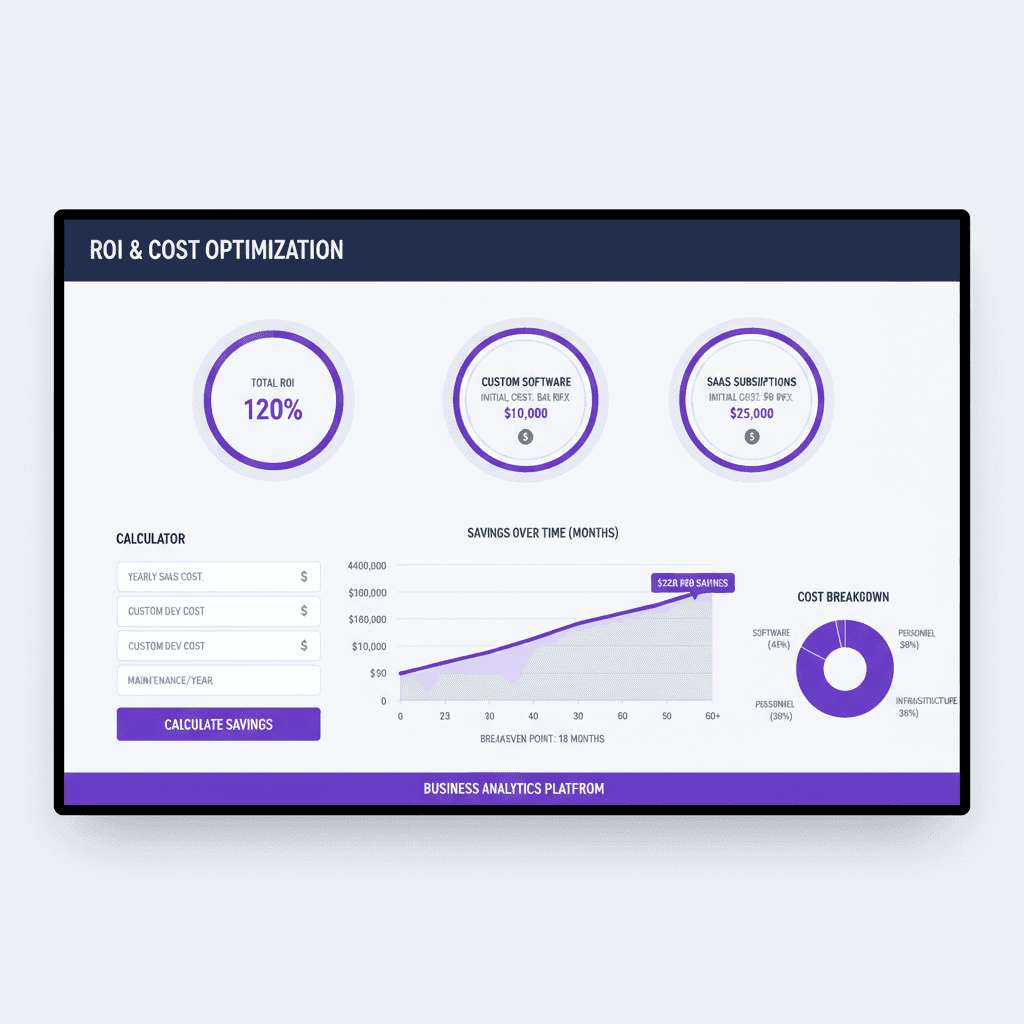
Small business owners are finally waking up to a harsh reality: those "affordable" $29/month SaaS subscriptions add up fast. By 2026, the average small business spends over $15,000 annually on software subscriptions, with many paying significantly more for tools that don't quite fit their needs.
But here's what most business owners don't realize – custom software often pays for itself within 18-24 months, then continues saving money year after year. The challenge? Most entrepreneurs never run the numbers to see the real return on investment (ROI) of custom solutions versus their current SaaS stack.
Let's break down exactly how to calculate custom software ROI, so you can make an informed decision about whether it's time to ditch those monthly subscriptions for good.
Understanding Your Current SaaS Costs
Before calculating potential savings, you need an honest assessment of what you're actually spending. Most business owners underestimate their true SaaS costs by 30-40% because they forget about:
Hidden SaaS Expenses:
- Annual vs. monthly billing discrepancies
- Per-user fees that scale with growth
- Integration costs between platforms
- Training time for new employees
- Data export fees when switching platforms
- Premium features that become "essential"
- Overage charges for usage limits
Start by listing every software subscription your business pays for. Include obvious ones like CRM systems, email marketing platforms, and accounting software, but don't forget smaller tools like scheduling apps, social media management platforms, and project management systems.
For restaurants, this might include POS systems, reservation platforms, inventory management, staff scheduling, and delivery integrations. Contractors often pay for estimating software, project management tools, client communication platforms, and invoicing systems. The list grows longer every year.
Real Example: A 15-employee marketing agency we worked with thought they spent $400/month on software. After a thorough audit, their actual costs were $847/month – over $10,000 annually. They were paying for duplicate functionality across multiple platforms and had forgotten about several "small" subscriptions that auto-renewed.
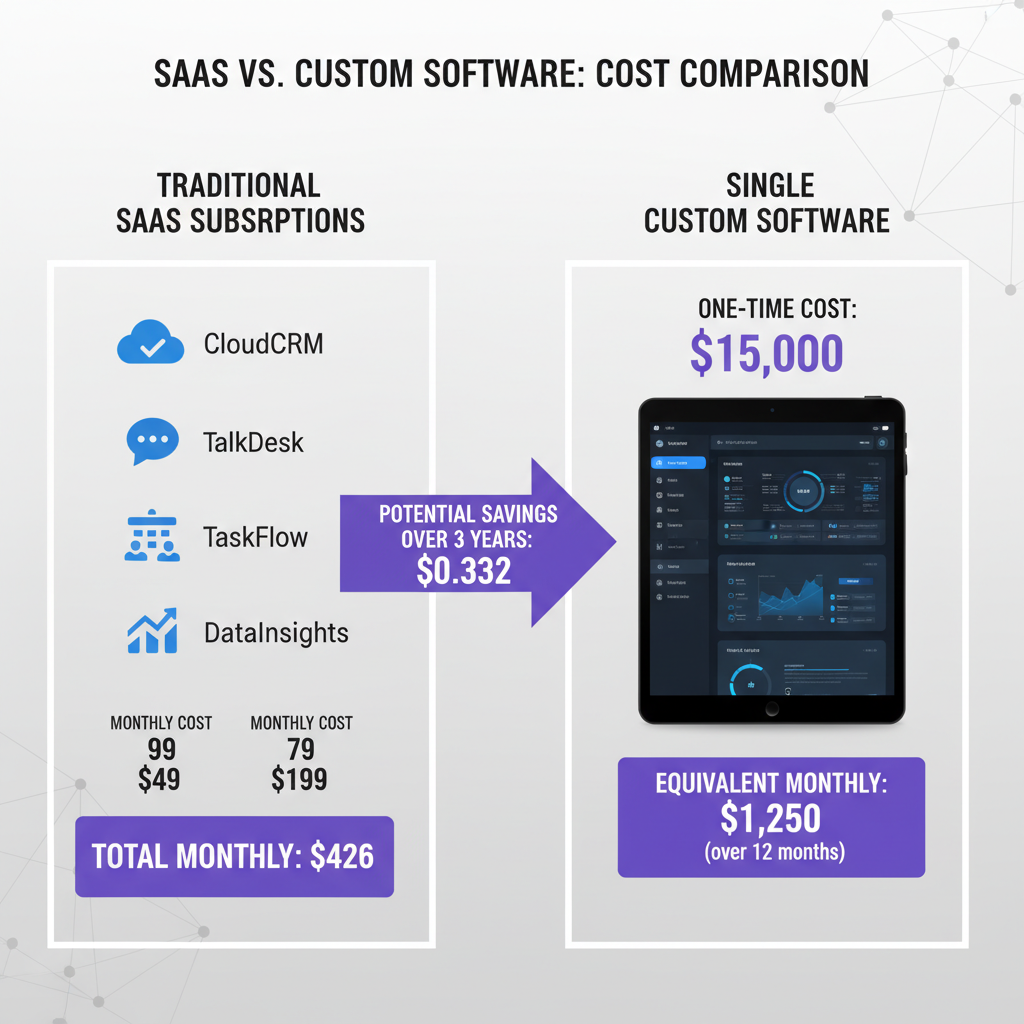
The Custom Software ROI Formula
Calculating ROI for custom software requires looking beyond simple upfront costs. Here's the formula that gives you the complete picture:
ROI = (Total 5-Year Savings - Custom Software Investment) / Custom Software Investment × 100
Let's break down each component:
Total 5-Year Savings includes:
- Eliminated SaaS subscription fees
- Reduced training costs (one system vs. multiple)
- Eliminated integration expenses
- Productivity gains from streamlined workflows
- Reduced data entry and manual processes
- Avoided cost increases from SaaS providers
Custom Software Investment includes:
- Initial development costs
- Ongoing maintenance (typically 15-20% annually)
- Training on the new system
- Data migration expenses
Real-World ROI Calculations
Let's work through actual examples to show how the math works in practice.
Case Study 1: Small Restaurant Chain (3 locations)
Current SaaS Stack:
- POS System: $189/month per location = $567/month
- Reservation Platform: $249/month
- Inventory Management: $149/month
- Staff Scheduling: $89/month
- Email Marketing: $79/month
- Analytics Dashboard: $99/month
- Total Monthly: $1,232 ($14,784/year)
Custom Solution Investment:
- Development Cost: $45,000
- Annual Maintenance: $6,750 (15%)
- Training: $2,000
- Total First Year: $53,750
5-Year Comparison:
- SaaS Costs (with 8% annual increases): $85,440
- Custom Software Costs: $80,750
- Net Savings: $4,690
- ROI: 10.4%
But this example doesn't account for productivity gains. The restaurant saved 15 hours per week on manual processes, worth approximately $11,700 annually. Including these gains:
- Total 5-Year Savings: $63,190
- ROI: 140%
Case Study 2: Mid-Size Contracting Company (25 employees)
Current SaaS Stack:
- CRM System: $150/month
- Project Management: $299/month
- Estimating Software: $189/month
- Invoicing Platform: $89/month
- Document Management: $149/month
- Time Tracking: $125/month
- Client Portal: $99/month
- Total Monthly: $1,100 ($13,200/year)
Custom Solution Investment:
- Development Cost: $68,000
- Annual Maintenance: $10,200
- Training: $3,500
- Total First Year: $81,700
5-Year Benefits:
- Eliminated SaaS costs: $76,230 (with increases)
- Productivity gains: $45,000 (better project tracking, automated invoicing)
- Reduced errors: $15,000 (fewer data entry mistakes)
- Total Benefits: $136,230
- ROI: 200%
Factors That Increase Custom Software ROI
Several factors can dramatically improve your ROI calculation:
Business Growth: SaaS costs scale with users, but custom software doesn't. A business growing from 10 to 25 employees might see SaaS costs double, while custom software costs remain largely fixed.
Industry-Specific Features: Generic SaaS tools often require workarounds or manual processes for industry-specific needs. Custom CRM systems built for your exact workflow eliminate these inefficiencies.
Integration Complexity: The more systems you need to connect, the higher the cost and complexity. Custom solutions can integrate everything into one platform, eliminating the need for expensive middleware or manual data transfers.
Data Ownership: With custom software, you own your data completely. No export fees, no vendor lock-in, and no risk of losing access if you stop paying subscriptions.
Automation Opportunities: AI automation can be built directly into custom systems, eliminating repetitive tasks that currently require human intervention.
When Custom Software ROI Makes Sense
Not every business should immediately switch to custom software. The ROI calculation works best when you have:
High Monthly SaaS Costs: Generally $800+ per month in software subscriptions makes custom solutions financially attractive.
Stable Business Processes: If your workflows change constantly, SaaS flexibility might be worth the ongoing costs. But if you've settled into consistent processes, custom software can optimize them perfectly.
Growth Plans: Fast-growing businesses often see SaaS costs spiral out of control. Custom solutions scale much more cost-effectively.
Industry-Specific Needs: The more specialized your requirements, the more likely custom software will provide better ROI than generic SaaS tools.
Team Size: Businesses with 10+ employees typically see better ROI from custom solutions, as per-user SaaS costs become significant.
Calculating Productivity Gains
The hardest part of ROI calculations is quantifying productivity improvements. Here are specific metrics to track:
Time Savings:
- Hours spent on data entry across platforms
- Time switching between different systems
- Manual report generation
- Duplicate data entry
- System maintenance and updates
Error Reduction:
- Costs of fixing data entry mistakes
- Lost revenue from billing errors
- Time spent reconciling conflicting information across systems
Process Improvements:
- Faster customer onboarding
- Reduced time to complete projects
- Improved customer communication
- Better reporting and decision-making
For restaurant operations, this might mean faster table turnover, better inventory accuracy, and reduced food waste. For contractors, it could be faster project completion, better cost tracking, and improved client satisfaction.
Building Your ROI Model
Create a spreadsheet that tracks these key metrics over 5 years:
Year 1: Custom software development and implementation costs, plus remaining months of current SaaS subscriptions during transition.
Years 2-5: Annual maintenance costs for custom software vs. projected SaaS costs (including typical 6-8% annual increases).
Productivity Gains: Conservative estimates of time savings and error reduction, calculated monthly and extended over the full period.
Hidden Benefits: Factor in improved customer satisfaction, better data insights, and competitive advantages that are harder to quantify but add real value.
Making the Decision
Remember that ROI calculations are just one factor in your decision. Also consider:
Risk Tolerance: Custom software requires a larger upfront investment but provides long-term stability. SaaS offers lower initial costs but ongoing payment obligations and less control.
Technical Capability: Do you have the internal expertise to manage custom software, or will you need ongoing development support?
Business Strategy: If you plan to sell your business soon, the improved processes and data ownership that come with custom software can increase your company's value.
Competitive Advantage: Custom software can provide capabilities your competitors don't have, potentially opening new revenue streams or improving customer retention.

Common ROI Calculation Mistakes
Avoid these errors when running your numbers:
Underestimating SaaS Growth: Most businesses add new software tools over time. Factor in likely additions to your software stack.
Ignoring Integration Costs: Connecting multiple SaaS platforms often requires expensive middleware or custom API work.
Overestimating Development Costs: Many business owners assume custom software costs more than it actually does. Get accurate pricing before making assumptions.
Forgetting Maintenance: Custom software requires ongoing updates and support, typically 15-20% of initial development costs annually.
Not Valuing Data Ownership: The ability to export, analyze, and control your data completely has significant long-term value.
Next Steps
The math is clear: for most established small businesses spending $800+ monthly on software subscriptions, custom solutions provide substantial ROI within 2-3 years. The key is running accurate calculations based on your specific situation.
Ready to see what custom software could save your business? Start with a detailed audit of your current software costs, then explore how custom development could streamline your operations while reducing ongoing expenses.
The transition from SaaS subscriptions to custom software is one of the smartest investments growing businesses can make – when the timing and numbers are right.
Contact our team today for a free ROI analysis of your current software stack. We'll show you exactly how much custom software could save your business over the next five years, with no obligation to move forward.