
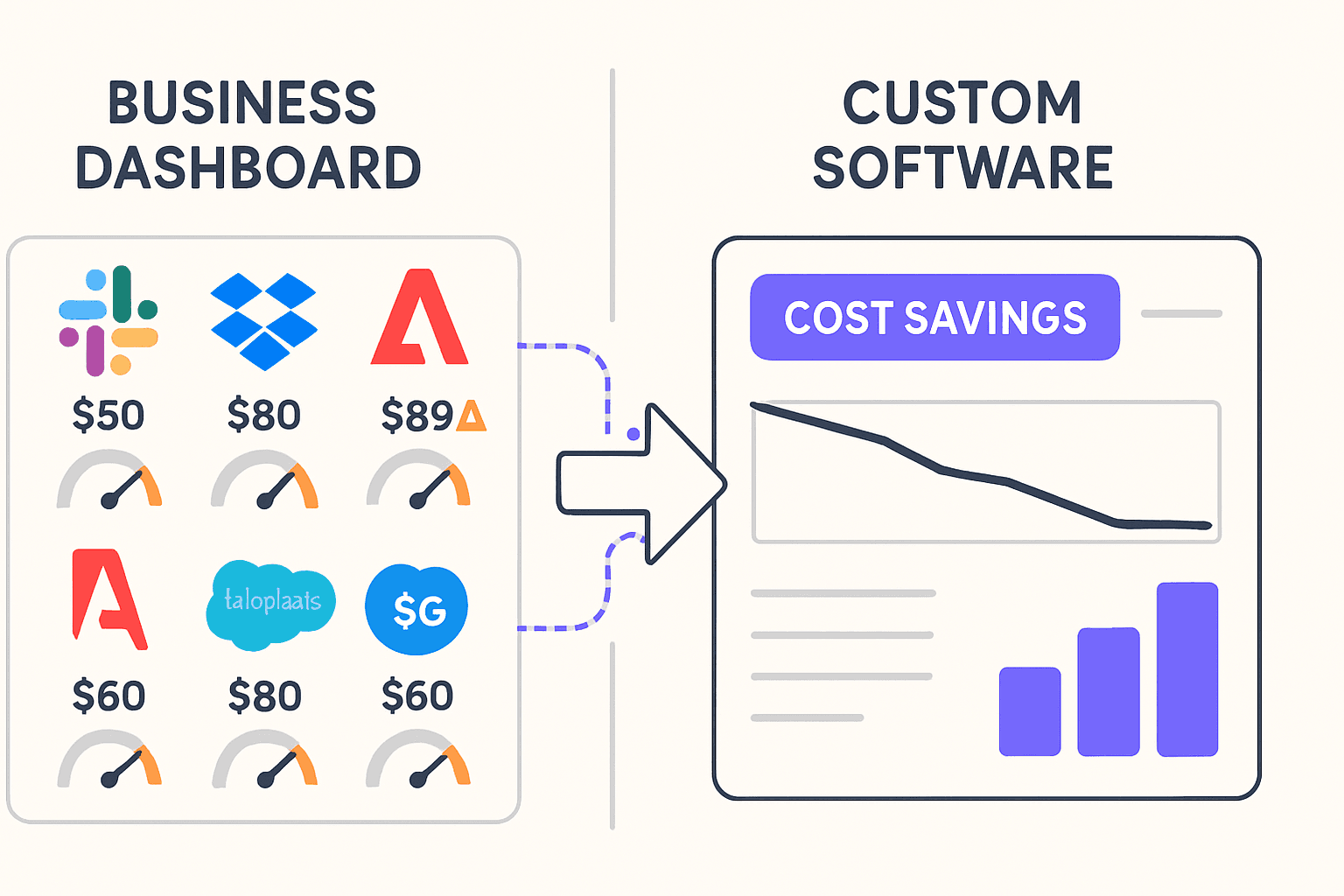
You open the business card statement and count a dozen software charges. A few you recognize. A couple you can't place. Each one looked small when someone signed up. That is how bloat works. The true cost of SaaS stack bloat in small business in 2026 is not the sum of those charges. It is the subscriptions plus the seats nobody uses, the tools that glue the apps together, the hours your team spends copying data between them, and the price of getting your data out later. We can't give you an honest national average for that number. We can show you how to find yours in an afternoon. If you're weighing whether to keep paying or build, our guide to custom software vs SaaS for small business covers the bigger decision. This post is about measuring the problem first.
What SaaS stack bloat actually is
SaaS means software as a service: tools you rent by the month or year instead of owning. Your "stack" is every one of those tools the business pays for. Bloat is what happens when the stack grows faster than the work it supports.
It usually shows up in three shapes:
- Overlap. Two or three tools do the same job. A CRM sends email, and so does your email platform. Your project tool has a client portal, and you pay for a separate one.
- Underuse. You pay for a higher tier for one feature, or for seats held by people who left or never logged in.
- Disconnection. The tools don't share data, so a person or a paid connector carries information from one to the next.
None of this means software is the problem. Most businesses depend on it. In the U.S. Census Bureau's 2023 Annual Business Survey, reported in 2025, 59.0% of employer businesses called cloud-based technology "very important" to their processes, and 58.9% said the same of specialized software. The question isn't whether to run software. It's how many separate rented pieces you need to do it.
The five layers of cost most owners never add up
The monthly fee is the layer you see. The other four rarely land on one statement, which is why the total surprises people.
1. Sticker price, and how it climbs
Most business tools charge per user, per month. A per-seat price multiplies twice: by headcount and by twelve. Add a hire and every per-seat tool gets more expensive at once. Tiers add a second climb. The feature you need, such as automation, custom fields or API access, often sits one plan up. You pay for the whole plan to get one feature.
2. The glue between tools
When apps don't talk to each other, businesses buy middleware: a connector service that moves data between apps on a trigger. Zapier and Make are the common ones. They work, but they are another subscription, usually priced by how many tasks run. They also add another place for things to break quietly. A changed field name in one app can stop a sync for days before anyone notices. We cover the trade-offs in when a Zapier alternative makes sense for a small business.
3. The manual work in between
This is usually the biggest layer and the least visible. Someone re-types a booking into the CRM. Someone exports a spreadsheet so the invoice matches the job. Someone checks three tabs to answer "where is my order?" None of it shows up as a software charge. It shows up as payroll hours, slower answers and errors. To price it, count the weekly hours a person spends moving data between systems and multiply by what that hour costs you, wages and overhead included.
4. The cost of leaving
Getting data into a SaaS tool is easy. Getting it out in a usable shape is not always. Exports may cover contacts but not history, attachments or automations. Your workflows, templates and reports live in the vendor's format and don't move with you. That switching cost is real, and it's why many businesses keep paying for a tool they've outgrown. Before you renew anything, check what the export actually includes.
5. Access and offboarding sprawl
Every tool is another login, another set of permissions and another place customer data is stored. When someone leaves, each account has to be shut off by hand. With a dozen tools, one gets missed. That is a security exposure, not just an annoyance. How you handle customer data across vendors can also raise privacy or compliance questions. Those belong with your own attorney or compliance adviser, not a software blog.
Why the number stays hidden
Small firms make up 99.9 percent of U.S. businesses, according to the Office of Advocacy at the SBA in its 2026 small business FAQ. Very few of them have a procurement team watching renewals. Bloat survives because no one person sees the whole bill. Some tools sit on the owner's card, some on a manager's, and some are billed annually, so they surface once a year. Free trials convert to paid plans. A tool one person bought for one project keeps renewing after the project ends.
The cost is also split across budget lines. Subscriptions sit in software. Connector fees sit somewhere else. The manual work sits in payroll. Nobody adds the three together, so nobody sees that the "cheap" stack costs more than it looks. If you see these patterns already, our list of signs your business has outgrown its SaaS tools will feel familiar.
How to audit your stack in one afternoon
You don't need special software for this. A spreadsheet and the last twelve months of card and bank statements are enough.
- Pull every recurring charge. Search 12 months of statements on every card and account the business uses. Annual renewals only appear once, so a single month will miss them.
- Name an owner for each tool. If no one claims it, that's your first cancellation candidate.
- Count seats paid against seats used. Most admin panels show last login dates. A seat with no login in 60 days is a seat you're donating.
- Write down what each tool actually does for you. Not what it can do. What your team uses it for, in one line.
- Map where the data goes. For each tool, note what flows in, what flows out and whether a person or a connector moves it.
- Estimate the manual hours. Ask the people doing the work. Weekly hours spent re-entering, exporting or reconciling are the hidden layer.
- Check the exit. Note the renewal date, the cancellation terms and what the export includes.
Here is a simple layout for the sheet:
| Column | What to record | Why it matters |
|---|---|---|
| Tool and plan | Name, tier, monthly or annual billing | Shows tier creep and annual surprises |
| True monthly cost | Annual charges divided by 12, plus add-ons | Puts every tool on the same scale |
| Seats paid / seats active | From the admin panel's last-login data | Finds cash you can recover this month |
| Job it does | One line, in your words | Exposes overlap between tools |
| Data in / data out | Which tools it feeds or depends on | Reveals where connectors and re-typing live |
| Manual hours per week | Time people spend moving its data | Prices the invisible layer |
| Renewal and export | Renewal date, notice period, export contents | Tells you when and how you can leave |
Add the true monthly cost column, the connector fees and the manual hours at your loaded hourly rate. That total, times twelve, is your real annual stack cost. It is almost always higher than the subscription total alone.
What to do with what you find
An audit gives you four options for each tool. Most businesses use all four.
Cancel or downgrade
Unclaimed tools, empty seats and plans paid for one unused feature go first. This is the fastest money back and needs no project.
Consolidate inside what you keep
If two tools overlap, pick the one your team uses more and turn off the other. Be honest about whether the survivor truly covers the job, or whether you're trading a subscription for a workaround.
Integrate what stays
Some tools should stay rented. Accounting and payroll software are good examples, because they track tax rules you don't want to maintain. The goal for those is clean connections through their APIs. An API is the official doorway a vendor provides so other software can read and write its data. Our guide to API integration vs native features explains when connecting beats rebuilding.
Build the core you run every day
The tools that hold your actual workflow are different. Think of your pipeline, your customer records, your bookings, your support and your portal. When four or five rented tools are stitched together to do one job, one system built around that job can replace the stitching.
When building beats paying: how to run the comparison
We won't hand you a made-up three-year chart. Your numbers are the only ones that matter, and the audit just gave them to you. Here's the honest comparison.
The cost of staying: your real annual stack cost from the audit, for the tools a build would replace, projected forward. Include expected hires, since per-seat tools grow with headcount. Include tier upgrades you already know you'll need.
The cost of building: the build itself, plus hosting, any third-party services the system still uses, and ongoing support. Our breakdown of what a custom app really costs lays out the tiers we publish, which run from $15,000 to $100,000 and up depending on scope. Hosting, third-party subscriptions and ongoing support are scoped separately in a proposal, so count them as their own lines.
If the cost of staying, over the years you expect to run the system, is close to or above the cost of building, building deserves a serious look. If it's far below, keep renting and fix the integrations. A build also changes things a spreadsheet doesn't capture. You own the code under the project agreement. A new hire doesn't trigger a dozen seat charges. And the workflow follows your process instead of a vendor's roadmap.
Building is not always the answer. If your process is still changing every month, or the job is simple and well served by one tool, renting is the better call. Be wary of anyone, including us, who says otherwise without seeing your audit.
What consolidation looks like in practice
The clearest example from our own work is WRAPT, the wholesale operations platform we built for Hammont. It runs a 9-stage pipeline from lead to delivery, a client portal and an omnichannel support hub in one system. The hub includes TAMI, a web-chat agent, so the team sees its chat conversations alongside every other support channel. Done with rented tools, that is a CRM, a portal product and a help desk, plus connectors between them.
A smaller example is the booking site and captain's CRM we built for Sand Bar Joe's. Bookings and customer records live in the same system, so a booking doesn't need to be carried by hand from a booking widget into a separate contact list.
Neither project needed to replace everything. Accounting, payments and email delivery can stay with specialist vendors and connect in. For email, we're a Mailchimp partner, and we say so whenever we mention it. A business that keeps Mailchimp for campaigns can connect it to a custom system rather than paying for overlapping email features elsewhere.
Frequently Asked Questions
What is the true cost of SaaS stack bloat for a small business?
It's the subscription total plus four costs that rarely show up on one bill: seats and tiers you don't use, connector tools like Zapier that link your apps, staff hours spent re-entering data between systems, and the cost of exporting data when you switch. There's no reliable national average for the total. The way to know yours is to audit 12 months of statements and add the manual hours at your loaded hourly rate.
How do I find all the software subscriptions my business is paying for?
Search 12 months of statements on every business card and bank account, because annual renewals only appear once a year. List each recurring charge, assign an owner and check the tool's admin panel for active seats and last login dates. Anything nobody claims, or any seat unused for 60 days, is an early cancellation candidate. A shared spreadsheet is enough to do this.
Is it cheaper to build custom software than to pay for SaaS?
Sometimes. Compare the real annual cost of the tools a build would replace, including connectors and manual hours, against the build plus hosting, third-party services and ongoing support. iOLab Digital publishes custom app tiers from $15,000 to $100,000 and up. If staying costs about the same or more over the years you'll run the system, building is worth scoping. If not, keep renting and fix integrations.
Which SaaS tools should a small business keep instead of replacing?
Keep tools that do a specialist job well and change with outside rules, like accounting, payroll and payment processing. Keep anything simple that one tool handles fully. The best candidates for replacement are the tools stitched together to run your core workflow, such as pipeline, customer records, bookings, support and client portals. For tax treatment of software spending, ask your accountant.
Start with the audit, then decide
Run the audit first. Cancel what nobody uses. Then look at what's left: the tools holding your daily workflow together with connectors and copy-paste. If that's where your money and hours go, that's the conversation worth having. We build custom CRMs around how a business already runs, from our base in Medford, for businesses across Burlington County, South Jersey, the Philadelphia metro and beyond. Bring your audit sheet and we'll tell you plainly whether a build makes sense or whether a few cancellations and better integrations will do.
Prices in this article are starting ranges published on iolab.co/pricing. Hosting, third-party subscriptions and ongoing support are scoped separately in your proposal.
iOLab Digital is a Microsoft Advertising, Semrush, SiteMinder and Mailchimp partner. Where this article mentions a tool we partner with, we say so.
Sources
Every outside claim in this article links to where it came from. These open in a new tab.
- U.S. Census Bureaucensus.gov
- Office of Advocacyadvocacy.sba.gov