
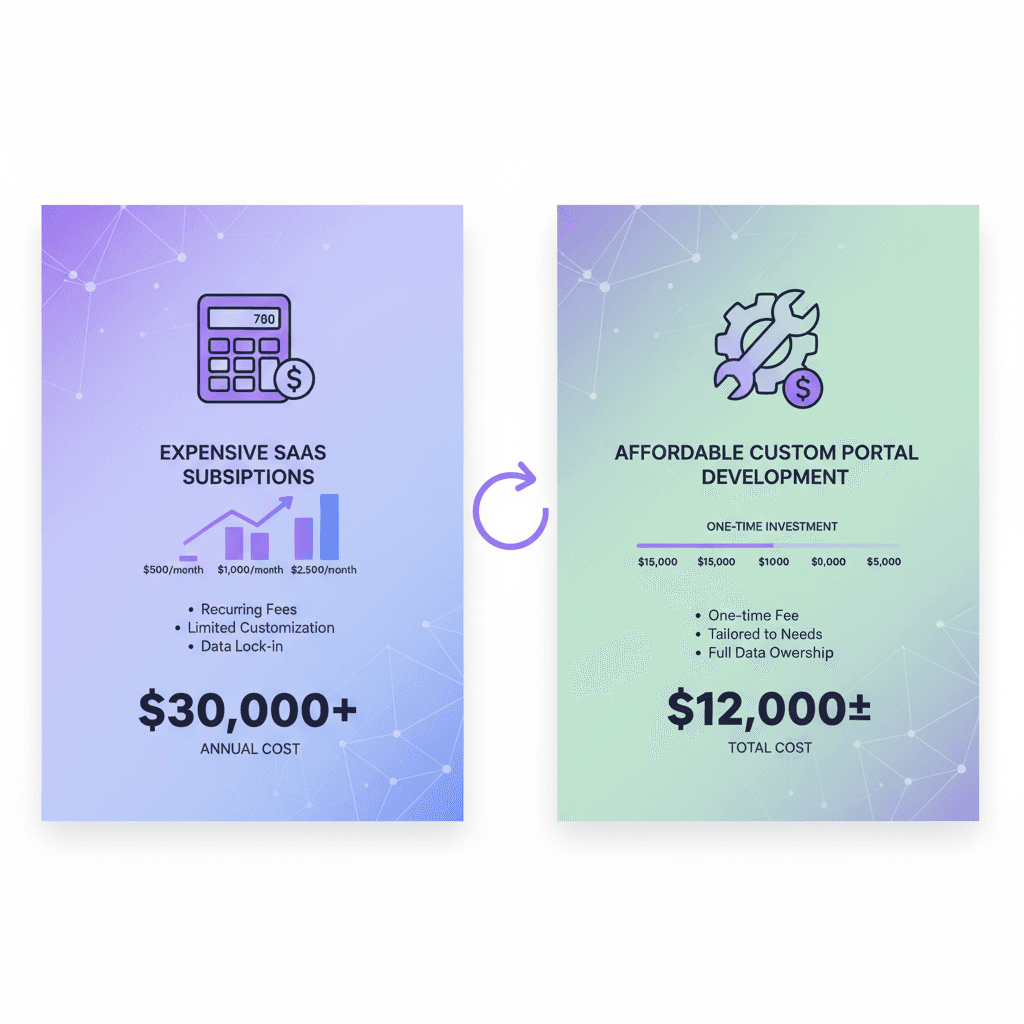
Small businesses are spending an average of $3,200 per month on client portal and project management SaaS tools in 2026—and most are only using 30% of the features they're paying for. What if I told you that a custom-built client portal could deliver exactly what you need for a fraction of that cost?
The client portal market has exploded, with businesses desperately seeking ways to streamline client communication, project delivery, and document sharing. But here's the problem: generic SaaS solutions are designed for everyone, which means they're perfect for no one. Meanwhile, custom client portal development has become surprisingly affordable, especially when you factor in long-term costs.
Let's break down the real numbers, examine what you're actually getting for your money, and see why savvy business owners are choosing custom over subscription in 2026.
The Hidden Costs of SaaS Client Portals in 2026
When you sign up for a client portal SaaS, you're not just paying the monthly subscription fee. The real cost includes:
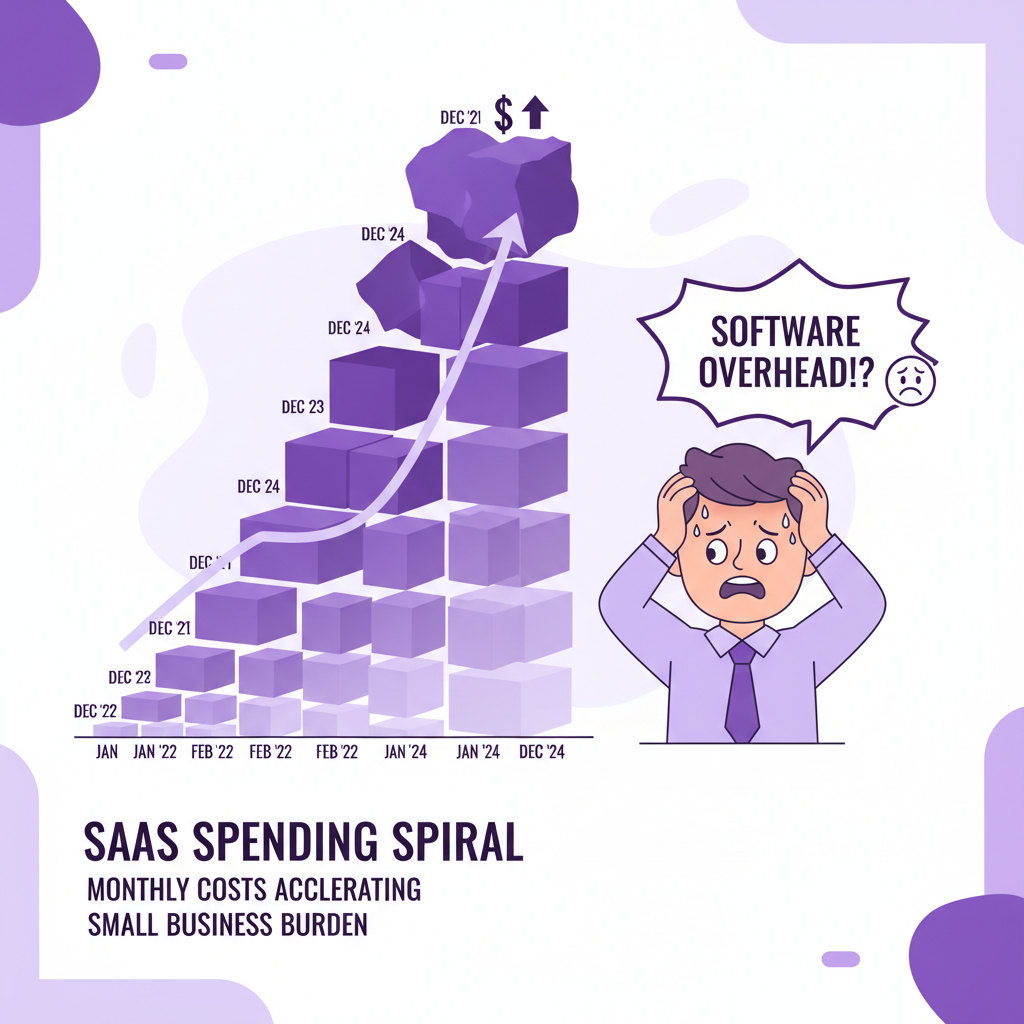
Subscription Fees That Keep Rising Popular client portal platforms now charge $150-500 per month for small business plans. But these prices aren't static. Most SaaS companies raise prices 10-15% annually, meaning your $200/month tool becomes $320/month within five years.
Integration Nightmares Need your client portal to talk to your CRM? That's another $50-100/month for integration tools. Want automated invoicing? Add another subscription. Before you know it, you're paying for three different tools just to create a cohesive client experience.
Per-User Pricing That Punishes Growth Most SaaS portals charge per user, per month. Start with 5 users at $40 each, and you're looking at $200/month. Grow to 15 users? Now you're at $600/month. Custom solutions don't penalize you for success.
Feature Limitations SaaS providers gate their best features behind enterprise plans. Need white-labeling? Custom branding? Advanced reporting? That's the $500+/month tier, even if you're a 10-person agency.
Data Lock-In Costs Want to switch platforms later? Expect to spend weeks and potentially thousands of dollars migrating your data, training staff, and rebuilding workflows.
What Custom Client Portal Development Actually Costs
Here's what most business owners don't realize: custom client portal development in 2026 is far more affordable than the "enterprise" SaaS plans that actually meet their needs.
Typical Custom Client Portal Investment A fully-featured custom client portal typically costs between $15,000-35,000 to develop. That might sound like a lot upfront, but let's do the math:
- SaaS Solution: $400/month × 36 months = $14,400 (and that's just the beginning)
- Custom Solution: $25,000 one-time investment
After just 5 years, the SaaS solution costs $24,000+ (assuming no price increases—which is unrealistic). The custom solution? Still $25,000.
What You Get for That Investment Unlike SaaS solutions that give you a generic experience, custom portals include exactly what your business needs:
- Unlimited users and clients
- Perfect integration with your existing systems
- Your branding throughout the entire experience
- Ownership of your code and data
- No monthly fees (except optional hosting/maintenance)
- Features built specifically for your workflow
Ongoing Maintenance Reality Most custom client portals require $200-400/month in hosting and maintenance—still a fraction of premium SaaS costs. This covers security updates, minor feature additions, and technical support.
Feature Comparison: Custom vs SaaS Client Portals
Let's get specific about what you're actually getting with each approach:
Standard Features (Both Options Provide)
- Secure client login
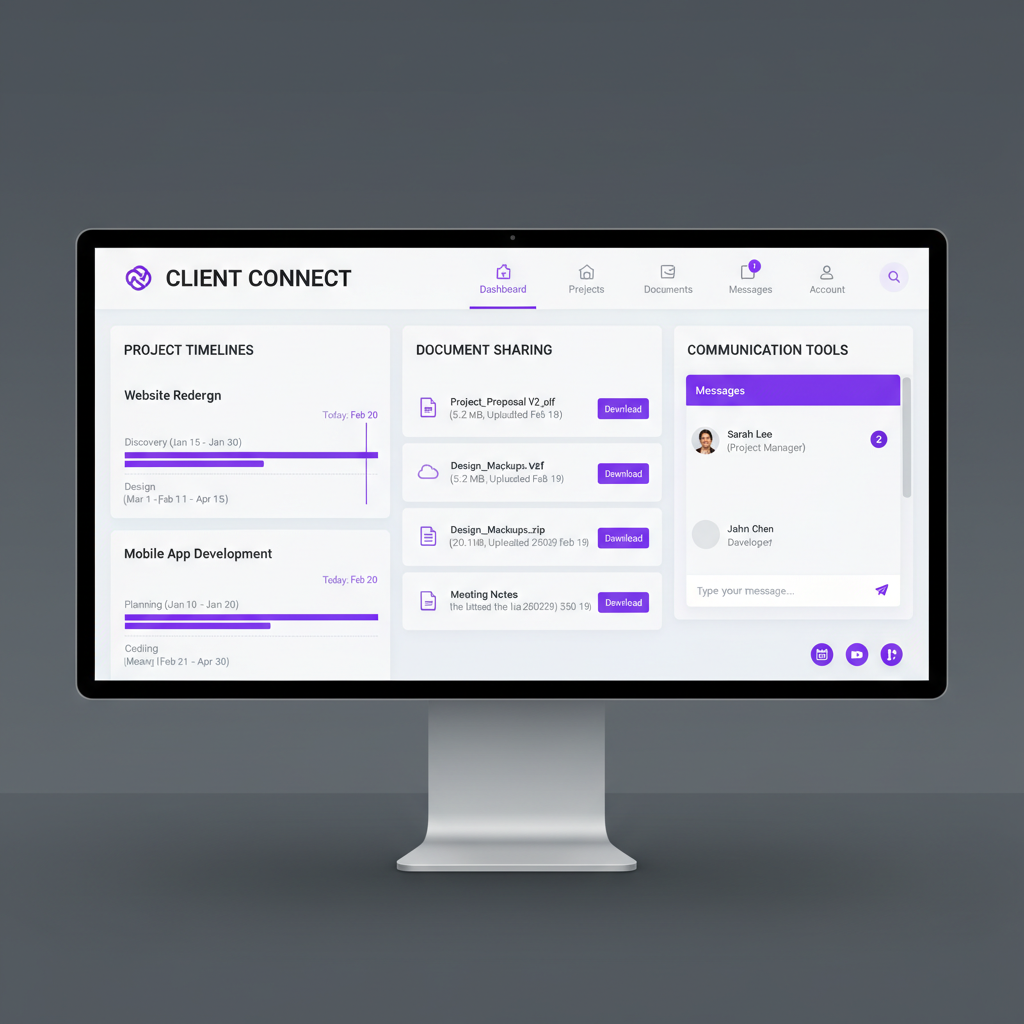
- Document sharing and storage
- Project progress tracking
- Basic messaging/communication tools
- Mobile-responsive design
Where Custom Solutions Excel
- Perfect CRM Integration: Your portal connects seamlessly with your custom CRM, creating a unified client experience
- Industry-Specific Features: Need contractor-specific progress photos? Restaurant order management? Legal case updates? Custom builds include exactly what your industry requires
- Advanced Automation: Integration with AI automation for intelligent client communications, automated progress updates, and smart document routing
- White-Label Experience: Your clients see your brand, your colors, your messaging—not "Powered by SaaS Company"
- Unlimited Scalability: Add users, storage, and features without subscription tier limitations
Where SaaS Solutions Fall Short
- Limited customization options
- Generic workflows that don't match your process
- Forced software updates that might break your workflow
- Data stored on external servers with potential access issues
- Features you don't need cluttering the interface
Real-World Cost Analysis: 5-Year Comparison
Let's examine two real scenarios based on businesses we've worked with:
Scenario 1: Marketing Agency (8 team members, 25 active clients)
SaaS Route:
- Year 1: $350/month × 12 = $4,200
- Year 2: $385/month × 12 = $4,620 (10% price increase)
- Year 3: $425/month × 12 = $5,100 (added users)
- Year 4: $470/month × 12 = $5,640 (price increase + features)
- Year 5: $520/month × 12 = $6,240 (continued growth)
- Total: $25,800
Custom Route:
- Development: $28,000
- Maintenance (5 years): $300/month × 60 = $18,000
- Total: $46,000
Wait—that makes SaaS look cheaper, right? Not when you factor in the integration costs, additional tools needed, and the fact that SaaS costs continue forever while custom development is a one-time investment.
Scenario 2: Professional Services Firm (15 team members, 50+ clients)
SaaS Route:
- Enterprise plan required: $800/month minimum
- Integration tools: $200/month
- Additional storage: $100/month
- 5-year total: $66,000+
Custom Route:
- Development: $35,000
- 5-year maintenance: $20,000
- Total: $55,000
The larger your business, the more dramatic the savings become.
Hidden Benefits of Custom Client Portals
Beyond the cost savings, custom client portals provide advantages that SaaS solutions simply can't match:
True Data Ownership Your client data, project history, and communications belong to you—not stored on servers controlled by a third party that could shut down, get acquired, or change their terms of service.
Perfect Mobile Experience Custom mobile apps can extend your client portal, giving customers native iOS and Android apps with your branding and optimized performance.
Integration Freedom Connect your portal to any system you use—accounting software, project management tools, or industry-specific applications—without worrying about whether the SaaS provider supports those integrations.
Competitive Advantage When your clients have a superior experience through your custom portal, they're less likely to shop around. Your portal becomes a differentiator, not just another generic interface.
Future-Proofing Business needs change, and custom portals can evolve with you. Need a new feature? Add it. Want to change the workflow? No problem. Try getting a SaaS company to modify their platform for your specific needs.
When SaaS Still Makes Sense
Custom isn't always the right answer. SaaS client portals might be better if:
- You're a very new business still figuring out your processes
- You need something operational within days, not weeks
- Your client portal needs are extremely simple
- You prefer predictable monthly expenses over larger upfront investments
- You don't have specific industry requirements
However, if you've been using SaaS client portals for more than a year and find yourself frustrated by limitations, pricing, or the generic experience, it's worth exploring custom development.
Making the Switch: Migration Strategy
Moving from SaaS to custom doesn't have to be disruptive. Here's how businesses typically make the transition:
Phase 1: Planning and Design (2-3 weeks)
- Document your current workflows and pain points
- Design the new portal with your specific needs in mind
- Plan data migration strategy
Phase 2: Development (4-8 weeks)
- Build the custom portal
- Set up integrations with existing systems
- Prepare training materials
Phase 3: Transition (1-2 weeks)
- Migrate client data
- Run both systems in parallel briefly
- Train team members
- Launch with select clients for testing
Phase 4: Full Launch
- Roll out to all clients
- Cancel SaaS subscriptions
- Collect feedback and iterate
Most businesses complete this transition in 2-3 months while maintaining full service to their clients.
The Technology Behind Affordable Custom Development
You might wonder how custom development became so affordable in 2026. Several factors have converged:
Better Development Frameworks Modern frameworks allow developers to build robust portals faster than ever before. What used to take 6 months now takes 6-8 weeks.
Cloud Infrastructure Hosting and scaling custom applications is incredibly affordable with modern cloud platforms. Most small businesses spend $50-150/month on hosting that can handle thousands of users.
AI-Assisted Development Development teams now use AI tools to accelerate coding, testing, and deployment, reducing development time and costs without sacrificing quality.
Component Libraries Pre-built, customizable components mean developers don't have to code every feature from scratch, dramatically reducing development time.
Getting Started: Your Next Steps
If the numbers make sense for your business, here's how to move forward:
Step 1: Calculate Your True SaaS Costs Add up all related subscriptions, integration costs, and per-user fees you're currently paying. Don't forget to factor in annual price increases.
Step 2: Define Your Requirements What features do you actually use? What's missing from your current solution? What would make your clients' experience significantly better?
Step 3: Get a Custom Quote Speak with a development team about your specific needs. A detailed quote should include development costs, timeline, hosting requirements, and ongoing maintenance.
Step 4: Consider Integration Needs How will your portal connect to your CRM, accounting software, or other business tools? Factor these requirements into your planning.
Step 5: Plan Your Timeline Most custom client portals take 6-12 weeks to develop and deploy. Plan your transition accordingly.
The Bottom Line: Custom vs SaaS in 2026
The math is clear: for most established small businesses, custom client portals cost significantly less than premium SaaS solutions while delivering a superior experience. The key is thinking beyond the monthly subscription fee to consider the total cost of ownership, scalability, and competitive advantage.
SaaS solutions got businesses started, but they're increasingly becoming expensive limitations rather than enablers. Custom development has evolved to become accessible, affordable, and fast—making it a realistic option for any business serious about client experience and long-term cost control.
Your clients deserve better than a generic portal with another company's branding. Your team deserves tools that match your actual workflow. And your business deserves to own the technology that powers your client relationships.
Ready to see what a custom client portal could do for your business? Contact our team for a free consultation and cost analysis based on your specific needs. We'll show you exactly how much you could save while dramatically improving your client experience.