
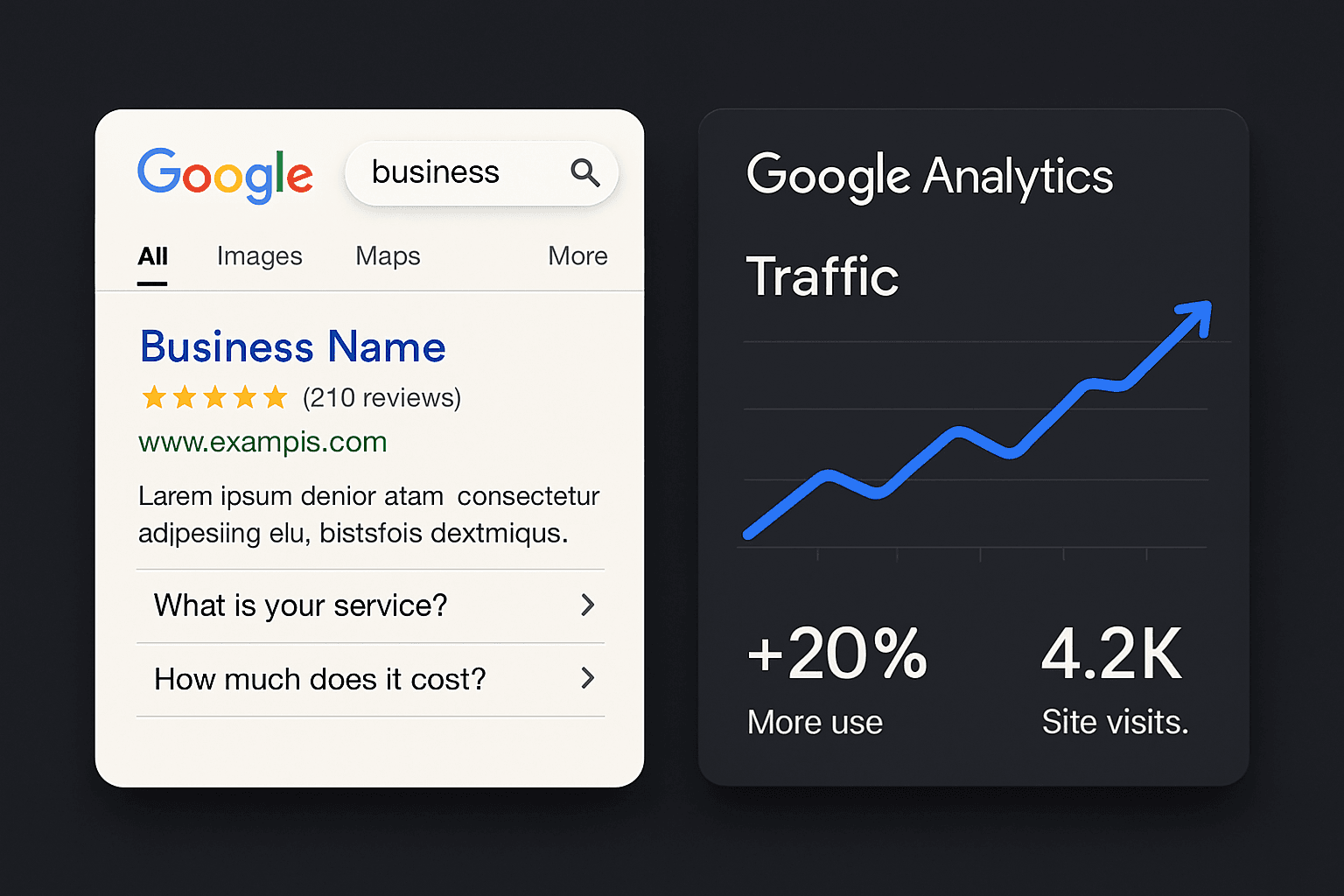
If you run a small business, you have probably been pitched AI for SEO a dozen times this year. SEO, or search engine optimization, is the work of getting your pages found on Google. Most of the pitch is "publish 100 posts a month." That is the wrong use. AI is good at research, first drafts and repetitive checks, and you still supply the expertise and the final read. This post covers what to hand to AI, what to keep, and what Google says. It is one piece of digital marketing for small business, and it only pays off if the basics underneath it are sound.
What Google Says About AI-Written Content
Start here, because it decides how much of the old advice survives. Google Search Central says generative AI can help with researching a topic and adding structure to original content. It also warns that using AI to generate many pages without adding value for users may violate its spam policy on scaled content abuse.
The same page says AI output can contain inaccuracies, which it calls hallucinations, and that you should manually fact-check and review AI-generated content before publishing. That one sentence rules out the "automatic blog on autopilot" approach for any business whose reputation depends on being right.
Google also published a guide on appearing in its AI features in Search. It tells site owners that a unique point of view helps, for example a first-hand review rather than a summary of what is already online. For a small business, that is good news. You have first-hand knowledge that a language model does not: your jobs, your customers, your town, your prices.
So the working rule is simple. AI drafts and sorts. A person who knows the work decides what gets published.
Where AI Actually Saves You Time
Vendors love to promise "10x more content." We have no source for a number like that. What we can describe is where the hours go in a normal SEO routine and which a tool can take back.
Research and planning
Sorting a list of 300 search phrases into groups by topic is slow by hand and quick for an AI tool. Give it your service list, your Google Search Console export and a list of your competitors' page titles. Search Console is the free Google report showing which searches already bring people to your site. Ask it to group phrases by intent: people ready to hire, people comparing, people just learning.
You then check the groups against what you know. A tool may lump "emergency furnace repair" with "furnace maintenance tips." You know those are different customers.
Drafting with a human edit
Use AI for an outline and a rough first pass on a service page or a how-to post. Then add what only you can. Add the price range you quote and the mistake you see most often. Add how the job differs in a Burlington County colonial versus a Philadelphia rowhouse. Cut anything generic. If a paragraph could sit on any competitor's site unchanged, it is not helping you.
Keep a short checklist for every draft: facts checked, prices checked, a real example added, and a named person approved it.
Technical housekeeping
Some tasks are tedious but well suited to automation:
- Drafting meta descriptions (the summary text under a result in Google) for pages that have none.
- Writing alt text (the description of an image for screen readers and search engines) for a photo library.
- Finding broken internal links and pages with missing titles.
- Flagging pages that two or more of your URLs compete for.
Ordinary crawling software finds most of these problems without AI. AI helps with the writing that follows. Review the output before it goes live, because a bulk-generated description that misstates a service is worse than a blank one.
Local SEO: Reviews, Profiles and Town Pages
For a restaurant in Medford, a plumber in Mount Laurel or a dental office in Cherry Hill, most searches carry a place name, or Google infers one. Three things matter most. One is your Google Business Profile, the free listing that shows on Maps. The others are your reviews and service pages that say something true about your service area.
AI helps with the middle one. It can draft a reply to each review in your voice, flag the negative ones for a person, and spot repeated complaints. A human should still send the replies to unhappy customers. We cover the full workflow in our post on automated review management and reputation monitoring.
Be careful with town pages. It is tempting to ask AI for 40 near-identical pages with only the town name swapped. That is the pattern the scaled content warning above is aimed at. Fewer pages, each with real local detail, is the safer bet. Real detail means jobs you have done in that town, local codes or conditions you work around, and photos you took.
For trades, the HVAC and plumbing CRM we design keeps call history, equipment records and follow-ups in one place. That record is also a source of honest, specific content ideas, because it shows which problems customers actually phone about.
Plan Seasonal Content From Your Own Data
You will see claims that AI can predict what people will search next month. We have no source showing that works reliably, so treat it as a planning aid, not a forecast.
Here is a method you can check. Open Search Console and compare last year's impressions by month for your service topics. If "AC tune-up" searches climbed in May, publish or refresh that page in March or April, so Google has time to find it. No one can promise a ranking by a date. What you control is being ready before demand arrives.
An AI tool is useful for the grunt work. It can pull monthly numbers into a table, suggest which pages to refresh first, and draft updated copy for your review. The judgment about what your shop can handle in a busy season stays with you.
Customer Questions Are Your Best Content Source
Your phone, inbox and website chat already hold the questions customers ask before they buy. A chatbot that logs those questions gives you a list of topics to write about, in the customers' own wording. This is the real SEO value of chat, not a claim that chat lowers bounce rate or lifts rankings, which we cannot source.
We built this kind of hub for WRAPT. The wholesale operations platform includes an omnichannel support hub with TAMI, a web-chat agent, alongside a client portal. A person on your side should read the logged questions each month, group them, and turn the top five into pages or FAQ entries. Our guide to AI chatbots for small business covers what a chatbot can and cannot handle.
Structured Data: Useful, With a Caveat
Schema markup is extra code that labels the content on a page, such as your business name, hours, services or an FAQ. AI tools can generate it quickly. Google's AI guidance says to follow the general guidelines and each feature's policies. It also says to validate the markup to confirm eligibility for Search features.
That matters because Google changes which features show for which sites. We have not re-checked the current rules for every markup type as of October 2026, so we will not promise a rich result. Add markup that matches what is visible on the page, run it through a validator, and treat any display in search as a bonus.
Showing Up in Google's AI Features
Google now runs generative AI features in Search. A common question is whether you need new tactics for them. According to Google's guide, you mostly do not. It says a page must be indexed and eligible to be shown with a snippet to appear in these features. It also says Google Business Profiles can help local businesses appear in AI responses.
The same guide lists things you can skip. It says you do not need llms.txt files or other special markup for Google Search. It also says you can ignore tactics like chunking content. Google announced the resource in its May 2026 Search Central blog post. It also points to a generative AI performance report in Search Console. Check it monthly to see what is happening on your site. That guidance covers Google only; other AI search tools may behave differently, and we have not verified how they choose sources.
What We Don't Know
We do not have a current, sourced figure for how many small businesses use AI for SEO, so we are not telling you there is a closing "advantage window." We also cannot tell you how fast AI-assisted pages rank, because it depends on your site's age, your competition and the quality of what you publish. Anyone quoting you a date or a position is guessing.
What holds regardless: pages that answer real questions with first-hand detail do better over time than pages that repeat what is already online. That is the point of Google's own guidance.
A 30-Day Starting Plan
- Week 1: Export your Search Console data and your Google Business Profile reviews. List your top 10 service pages and note which have thin or missing copy.
- Week 2: Use AI to group search phrases and draft meta descriptions and alt text. A person reviews every item before it goes live.
- Week 3: Rewrite two service pages with local, first-hand detail. Use AI for the outline and a rough draft only.
- Week 4: Set up a review-reply routine with a human sending anything sensitive. Add markup where it matches visible content and validate it.
After that, repeat monthly. Content that brings in leads should feed your follow-up. Connect it to AI-powered follow-up systems, so a visitor who asks a question hears back.
If you want a second set of eyes on the plan, we offer SEO and content strategy built around service intent and lead attribution. We scope it around how your business already runs, and we don't promise rankings.
Frequently Asked Questions
Can small businesses use AI for SEO without being penalized by Google?
Yes, if the content is useful and reviewed. Google's guidance says generative AI can help with research and structure, but generating many pages without adding value for users may violate its scaled content abuse policy. Fact-check everything, add first-hand detail, and publish fewer, better pages rather than volume.
What is the best way to use AI for local SEO?
Use it for repeatable work: drafting replies to Google reviews, grouping search phrases, and writing first drafts of service pages that you then edit with local detail. Keep a person in charge of anything customer-facing and sensitive. Avoid mass-producing near-identical town pages, since they add little value for readers.
Do I need llms.txt or special markup to appear in Google's AI answers?
According to Google's guide to generative AI features in Search, you do not. It says Google Search does not use llms.txt files or other special markup, and recommends foundational SEO instead: crawlable, indexed pages with unique, helpful content. Google Business Profiles can help local businesses appear in AI responses too.
How long does AI-assisted SEO take to show results?
Nobody can say with accuracy, and be wary of anyone who does. Timing depends on your site's age, competition, and how good the pages are. A practical approach is to publish or refresh seasonal pages a couple of months ahead of demand, then track Search Console impressions monthly rather than expecting a date.
Talk It Through With Us
If you are in Medford, Burlington County or the Philadelphia area, or anywhere else, and want help sorting what to automate and what to keep human, get in touch through iolab.co. We will start with your current pages and Search Console data, not a sales deck.
Sources
Every outside claim in this article links to where it came from. These open in a new tab.
- Google Search Centraldevelopers.google.com
- unique point of view helps, for example a first-hand review rather than a summary of what is already onlinedevelopers.google.com
- its May 2026 Search Central blog postdevelopers.google.com